
When it comes to four-character expressions in Korean, the first thing that comes to mind is the four-character idioms called sajaseong-eo, which undoubtedly represent a significant and fascinating facet of the Korean language learning journey.
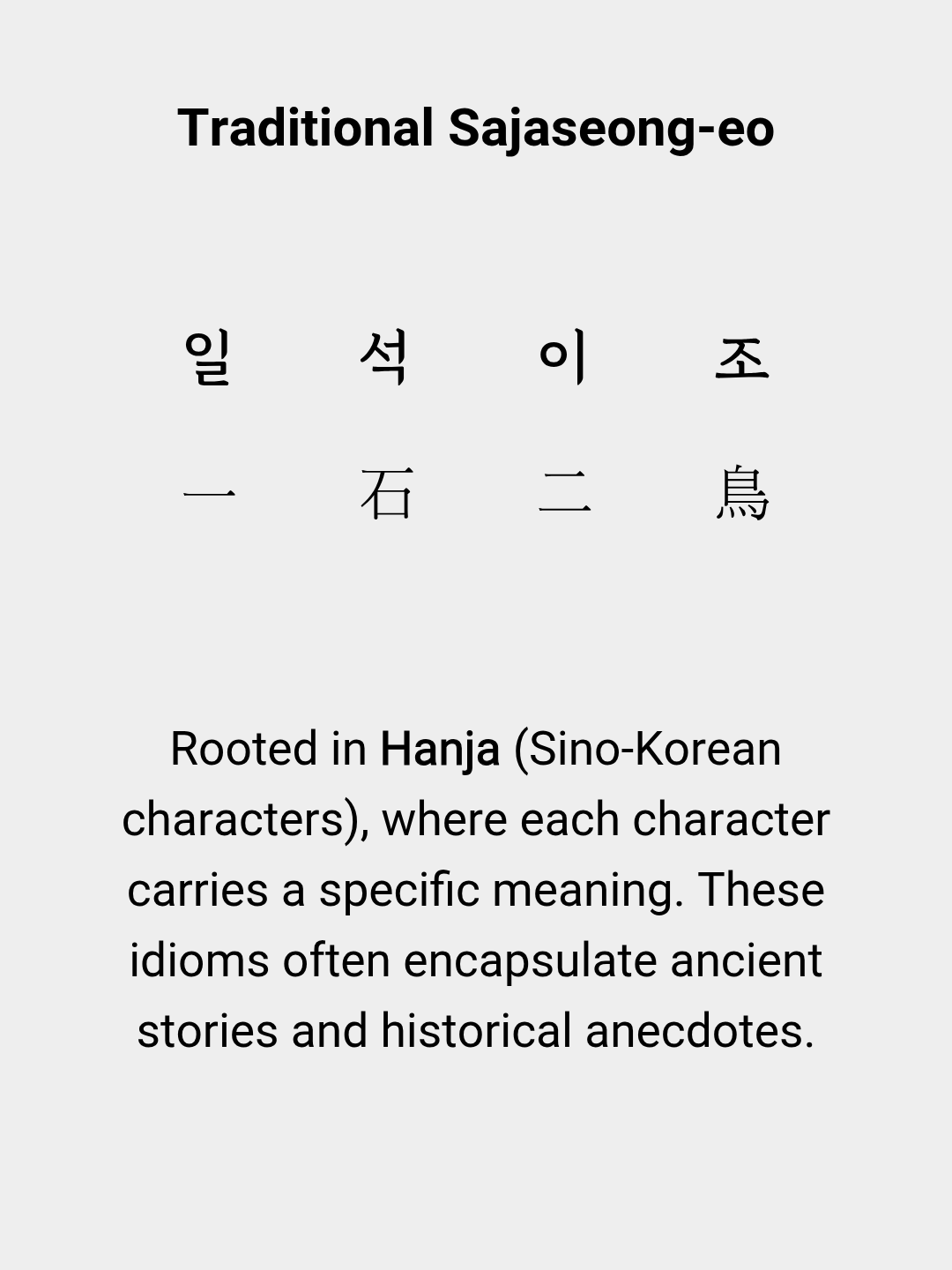
Sajaseong-eo are rooted in classical Chinese texts and consist of four Sino-Korean characters (Hanja). For those unfamiliar, Hanja refers to the Chinese logograms that were integrated into the Korean language; each character functions as a distinct building block of meaning.
Many of these four-character idioms have centuries-old stories and historical anecdotes layered behind them. Because of this condensed nature and narrative depth, traditional sajaseong-eo act like dense capsules of wisdom, functioning much like proverbs that deliver complex moral lessons in just four beats.
Because sajaseong-eo are so deeply embedded in the culture, there’s a subtle psychological effect at play: the four-character structure itself starts to carry a certain ‘aura.’ It’s as if any phrase squeezed into four syllables automatically gains a bit of gravitas, giving off the vibe of a timeless truth—even when it’s just modern slang.
It’s not a hard rule, but rather a subtle cultural intuition: when we hear something in four syllables, it instinctively feels more ‘final,’ more ‘truthful,’ or even a bit more ‘profound.’ This specific vibe is what allows modern slang to feel like a mini-philosophy, even when there’s no ancient story involved at all.
With this “four-character aura” in mind, let’s look at some modern neologisms. Even though these are pure slang, the way they are structured gives them a sense of permanence and philosophical depth.
1. The “Modern-Day Maxims”
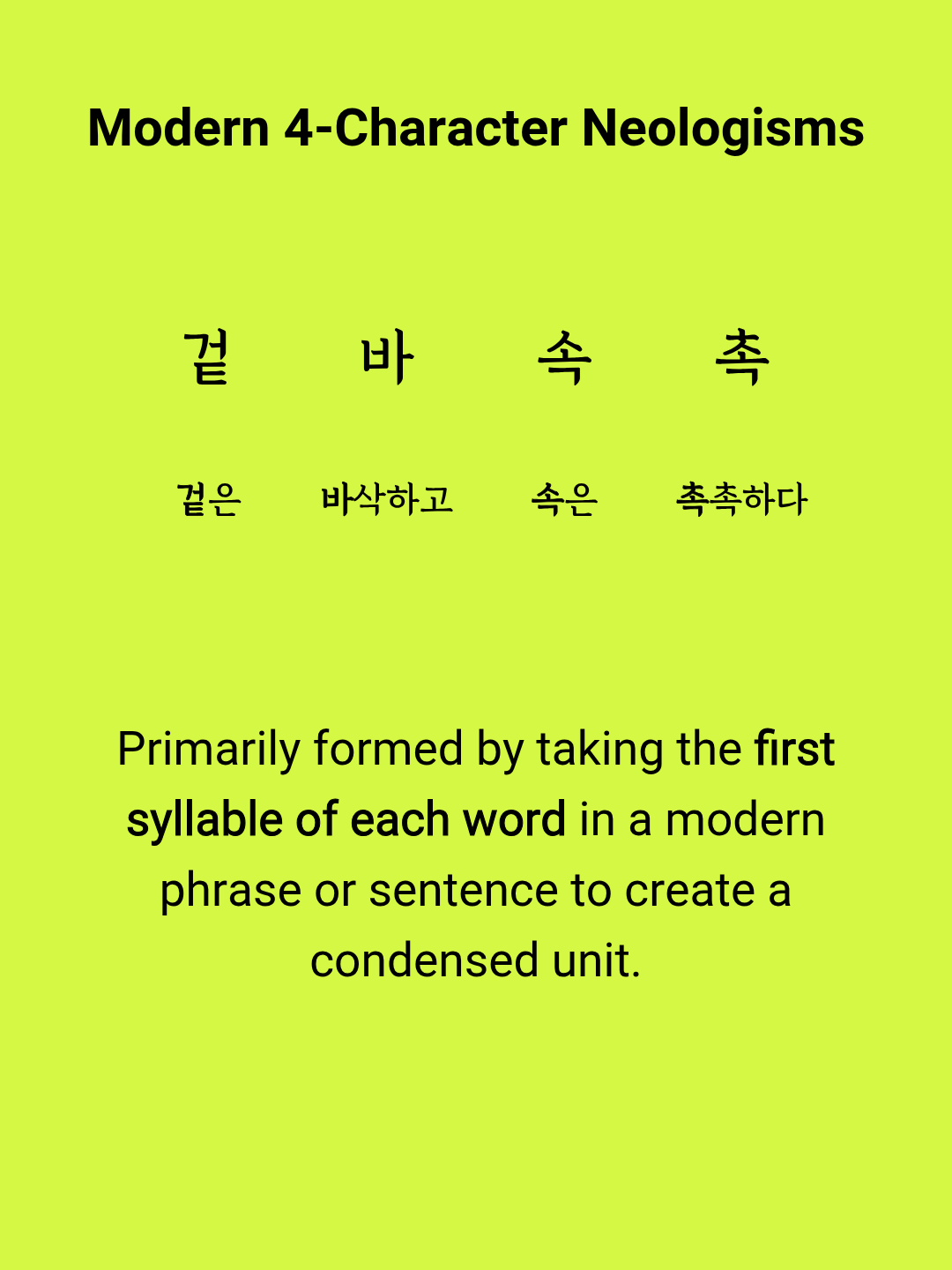
The following examples are clearly modern abbreviations with a completely different DNA. Traditional sajaseong-eo are made of Hanja, but these neologisms are often purely native Korean (Hangul). They follow a modern formation: taking the first syllable of each word in a phrase to create a brand-new, condensed unit.
Despite this difference in origin, the four-character format turns these casual abbreviations into something that feels like a definitive life philosophy.
- Hal-man-ha-an (할많하않): Short for “I have a lot to say, but I won’t” (Hal-mal-eun man-chi-man ha-ji an-neun-da). While it’s a simple contraction of a sentence, the moment it is condensed into four characters, it undergoes a psychological shift: it stops being just a statement and starts feeling like a definitive “concept.”
This expression is the go-to phrase for when you realize that verbalizing a situation is a futile waste of time and energy—especially when facing a profound, systemic problem that has already been discussed to death. By using those four beats, you aren’t just staying quiet; you are signaling a shared, weary understanding. It implies that the drama or the unfairness is so obvious that further explanation is unnecessary. - Geot-ba-sok-chok (겉바속촉): This is a purely Korean descriptive phrase shortened from: “Crispy on the outside, moist on the inside” (Geot-eun ba-sak-ha-go sok-eun chok-chok-ha-da). In the world of Korean foodies, this isn’t just a simple description; it’s the ultimate truth of food texture. Whether it’s fried chicken, a perfect pastry, or grilled pork belly, Geot-ba-sok-chok is the golden standard. By condensing this sensory experience into four rhythmic beats, it sounds less like a casual observation and more like a “culinary commandment”
- An-mul-an-gung (안물안궁): Standing for “I didn’t ask, and I’m not curious” (An mul-eo-bwa-tgo an gung-geum-ha-da). While the original full sentence can sound quite blunt or even rude in a social setting, condensing it into an-mul-an-gung creates a neutralizing effect. By using these four beats, you signal the specific “vibe” of the situation—turning a potentially harsh shut-down into a rhythmic, playful sting. It functions similarly to “TMI” or “Who asked?”, and the four-character structure makes the dismissal feel like a lighthearted meme rather than a serious insult.
2. The “Sajaseong-eo Imposters”
Below examples are the tricksters. They sound so much like traditional sajaseong-eo that they can easily fool even native speakers at first glance, although they were also formed by taking first syllables from a words or a phrase in a sentence.
- Nae-ro-nam-bul (내로남불): This has practically become a “modern classic” in the Korean lexicon. It is a clever abbreviation of the phrase: “If I do it, it’s romance; if others do it, it’s adultery” (Nae-ga ha-myeon ro-maen-seu, nam-i ha-myeon bul-lyun). What makes this expression particularly fascinating is its “hybrid” DNA—a mix of native Korean, the English-derived word “romance,” and the Hanja-based “Bul-lyun.” This linguistic melting pot gives the word a sharp, comic touch when used to describe a double standard. Despite its modern origins, the word is so widespread that it’s frequently mistaken for a traditional sajaseong-eo. It is used everywhere—from casual group chats to serious political news headlines—proving that even a hybrid neologism can gain instant authority and “classic” status once it’s polished into those four rhythmic beats.
- Bok-se-pyeon-sal (복세편살): At first glance, this looks like an obscure, scholarly sajaseong-eo that requires a dictionary to decipher. In reality, it is a clever contraction of the phrase: “Let’s live comfortably in this complex world” (Bok-jap-han se-sang pyeon-ha-ge sal-ja). It is essentially the Korean “YOLO” disguised as an ancient proverb.
- Ja-gang-du-cheon (자강두천): This one sounds like a legendary battle described in a history book. Even without knowing its origin, the phonetic rhythm makes it sound like it was pulled straight from an ancient Chinese text. However, it actually stands for: “A battle between two geniuses with massive egos” (Ja-jon-sim gang-han du cheon-ja-ui dae-gyeol). It’s often used sarcastically to describe two people stubbornly arguing or competing over something trivial, giving the petty argument a mock-epic feel.
Conclusion
Understanding these four-character neologisms is a shortcut to understanding the Korean psyche. It shows how the ancient weight of sajaseong-eo continues to influence how Koreans invent and perceive new words today. By learning these, you aren’t just expanding your vocabulary; you are learning to “feel” the language—capturing that subtle balance between humor, economy, and tradition that defines modern Korean communication.

A Xennial observer who has hovered on the internet since its early days. Fascinated by linguistic nuance, I unravel the cultural subtext of Korean pop culture and the ever-evolving world of online slang, going beyond dictionary definitions.
Leave a Reply